

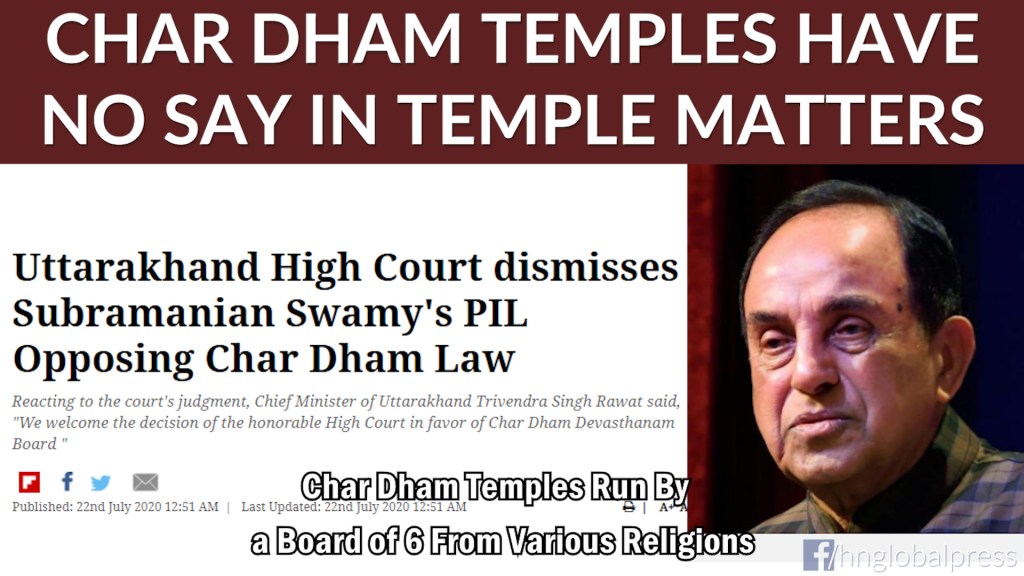
Under the economic crunch of Coronavirus many temples are collapsing, unable to meet basic costs and on top of this crores of rupees are extracted by cunning temple boards and even temple assets are being auctioned. Two of the world’s so-called richest temples have been stretched to meet basic costs for staffing and prasadam. Since 1949, Hindu temples in India have been victims of legislation to take control out of the hands of Hindus and ensure temple donations are syphoned for political purposes. Just last month, the Uttarakhand High Court dismissed a plea by Dr. Subramanian Swamy opposing the Char Dham Devasthanam Management Bill of 2019 which proposed to pave the way for the state government to take over more than 50 shrines in the state, including Char Dham — Gangotri, Yamunotri, Kedarnath and Badrinath. There is a long and disgusting history of temples in Tamil Nadu, Andhra Pradesh, Kerala and elsewhere having been stripped of all sustainability and value by these “secularized” governing boards. There are currently 5 major Devaswom boards in Kerala that administer more than 3000 Hindu temples in the state. And last month, the Supreme Court of India passed a judgement declaring the right of the Royal Family of Travancore to exercise their traditional shebait rights of administration at Shri Padmanabhaswamy Temple. As the fate of more than 50 temples in Uttarakhand, including Char Dham, currently hangs in the balances before the Courts, the Indic Collective has illustrated a comparison of restrictions currently faced by Uttarakhand’s Hindu temples versus the freedoms granted recently by the Supreme Court with regard to the Shri Padmanabhaswamy Temple ruling. 1. The current Char Dham board includes only 5 out of the 26 Board seats as traditional stakeholders in the temple management. Whereas at Shri Padmanabhaswamy Temple, the entire Advisory Board is currently presided over by Travancore Royal Family Representative. 2. The Garhwal Maharaja and Pujaris of Char Dham do not currently have any official in the governing administrative committee. Whereas at Shri Padmanabhaswamy Temple, the Maharaja and temple Priest occupy 2 seats of the 5-member Board that is presided over by the Maharaja as well. 3. At Shri Padmanabhaswamy Temple, the Maharaja has veto power on all major expenditure while the Temple Priest is the absolute authority on religious matters. Currently at the Char Dham Temples neither the Maharaja nor the Temple Priests have any say on expenditure or religious practices. 4. Currently at Shri Padmanabhaswamy Temple, all 5 members of the governing Board must be practicing Hindus. The 6 members of the Char Dham Board are not required to be Hindus. 6 members of any religion administer the Char Dham Temples without any say from the Garhwal Maharaja or the Temple Priests. 5. At Shri Padmanabhaswamy Temple, the Maharaja and head Priest have veto powers to override other members of the committee. Whereas at Char Dham, a quorum of 5 is required, making the 5 of 26 traditional stakeholders powerless. 6. The Maharaja of Travancore has the authority to go to court and change the committee if the nominees try to grab power. Whereas, there is no scope for the Garhwal Maharaj to approach the Court and change the committee if the government grabs power. The fate of more than 50 Hindu temples in Uttarakhand is currently before the Courts. (30 August 2020) ————————————— Visit us around the web: Facebook: https://facebook.com/HNGlobalPress Youtube: https://youtube.com/HinduismNow Twitter: https://twitter.com/HN_Global_Press Instagram: https://www.instagram.com/hinduismnowgp/ ————————————— #HinduismNow #News #Hinduism
 Visit Us @ facebook.com/hnglobalpress